QR vs. Code 128 for Small Asset Labels: A Practical Guide
12 August 2026 · qr code · code 128 · asset tracking · industrial labels · australia
When you're managing assets across an Australian industrial site, effective labelling isn't just about identification; it's about efficient tracking, maintenance, and compliance. Choosing the right barcode format for your asset labels, especially on smaller items, is a critical decision. Two popular contenders often come up: QR codes and Code 128 barcodes. But which one 'wins' when space is at a premium?
This article dives into a practical comparison, helping Australian operations, facilities, and asset managers cut through the technical jargon to make an informed choice. We'll explore the strengths and weaknesses of both formats, specifically focusing on their suitability for small asset labels in demanding industrial environments.
Understanding the Contenders: QR Code vs. Code 128
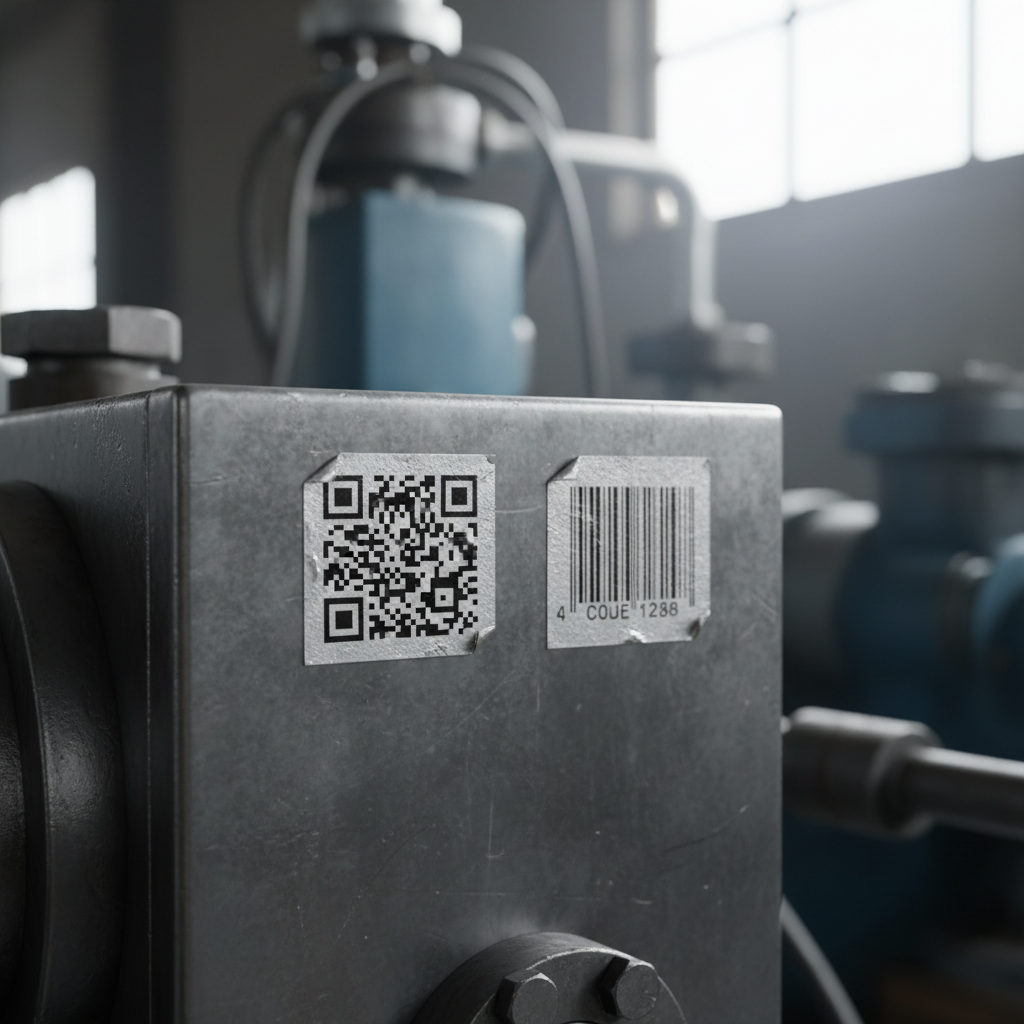
Before we pit them against each other, let's briefly introduce our two barcode champions. Both are designed to store information that can be quickly read by a scanner, but they do it in fundamentally different ways.
Code 128 Barcodes: This is a linear (1D) barcode, meaning the data is encoded horizontally. You'll recognise it as a series of parallel lines of varying widths. It's a high-density, alphanumeric barcode, widely used in logistics and shipping due to its ability to encode the entire 128 ASCII character set, including numbers, letters, and symbols.
QR Codes: A Quick Response (QR) code is a two-dimensional (2D) matrix barcode. Instead of lines, it uses a pattern of black squares arranged on a white background. This 2D nature allows it to hold significantly more data than a 1D barcode and also enables omnidirectional scanning – you don't need to align it perfectly with the scanner.
Data Capacity: How Much Information Can They Hold?
When dealing with small labels, data capacity is often the first major differentiator. You need to encode enough information without the label becoming unreadable.
Code 128: As a 1D barcode, its data capacity is limited by its length. While it can encode a good amount of alphanumeric data for a linear barcode (up to around 80 characters without becoming excessively long), every extra character adds to its horizontal size. On a very small label, this can quickly become a problem, forcing you to use smaller, harder-to-scan bars.
QR Codes: This is where QR codes truly shine. Their 2D structure allows them to pack a tremendous amount of data into a small space. A QR code can store over 4,000 alphanumeric characters, or even more numeric characters. This means you can embed extensive details like serial numbers, part numbers, maintenance schedules, manufacturer information, and even a URL linking directly to an asset's digital twin or service manual, all within a compact square.
The ability of QR codes to store significantly more data in a smaller footprint often makes them a preferred choice for comprehensive asset identification where detailed information is required directly on the label.
Scan Speed and Reliability in Industrial Settings
In a busy Australian warehouse or manufacturing plant, every second counts. Scan speed and reliability directly impact operational efficiency and accuracy.
Code 128: Linear barcodes generally require a scanner to be aimed relatively precisely across the full length of the code. If the code is slightly damaged, smudged, or partially obscured, the scanner might struggle to read it, leading to rescans and lost time. On small labels, even minor damage can render a Code 128 unreadable.
QR Codes: This is another area where QR codes have a distinct advantage. Thanks to their built-in error correction capabilities, QR codes can remain scannable even if a portion of the code (up to 30% or more, depending on the error correction level) is damaged, dirty, or obscured. Furthermore, their 2D nature means they can be scanned from almost any angle, speeding up the process and reducing user frustration. This 'omnidirectional' scanning is a huge plus in dynamic industrial environments.
Readability on Small Surfaces
This is the crux of the problem: which format performs better when shrunk down to fit a small asset?
Code 128: When you shrink a Code 128, the lines become thinner and closer together. This makes them much more susceptible to printing inaccuracies, smudges, and damage. A slight abrasion on a small Code 128 could wipe out critical bars, making it unreadable. The minimum printable size for a reliable Code 128 can still be quite large if you need to encode more than a few characters.
QR Codes: QR codes are inherently more robust at smaller sizes. The individual 'cells' (squares) within a QR code are discrete units. While they do get smaller, their distinct shape and the error correction ensure that even a tiny QR code can hold a surprising amount of data and remain scannable. For example, a 20mm x 20mm QR code can still be easily read by modern scanners, including smartphone cameras, even if the label is slightly scuffed.
Scanning Equipment and Accessibility
Who will be doing the scanning, and what equipment will they be using? This impacts the practicality of your chosen barcode.
Code 128: These barcodes are universally supported by traditional 1D barcode scanners, which are common in many industrial settings. They are cost-effective and robust. However, these scanners only read 1D codes. If you have other 2D codes (like data matrix) on site, you might need separate devices.
QR Codes: QR codes require 2D imagers or scanners. The good news is that most modern industrial scanners are now 2D imagers, meaning they can read both 1D and 2D codes. Even better, virtually every smartphone today has a built-in camera and apps that can scan QR codes. This democratises scanning, allowing maintenance teams, auditors, or even visitors (if appropriate) to quickly access information without needing specialised equipment. For field service technicians in remote Australian locations, a smartphone is often their most accessible scanning tool.
Cost and Implementation Considerations
While often overlooked, the cost of printing, labels, and scanning infrastructure plays a role in your decision.
Printing: Both formats can be printed using standard industrial label printers. The complexity often lies more in the label material itself – ensuring it's durable enough for your environment – rather than the barcode format. High-quality thermal transfer printers are excellent for both.
Labels: The cost of the physical label stock will be similar for both. The key is investing in a label material that can withstand your specific conditions (e.g., extreme temperatures, chemicals, abrasion, UV exposure from harsh Australian sun).
Scanning Infrastructure: If you already have a fleet of 1D scanners, introducing QR codes might mean upgrading to 2D imagers. However, the increasing ubiquity of 2D scanners and smartphone capabilities can significantly reduce this barrier. The ability to use existing smartphones can often offset the initial investment in 2D scanners.
The Verdict: QR Codes Lead for Small Asset Labels
When it comes to small asset labels in demanding Australian industrial environments, QR codes generally emerge as the clear winner. Their superior data capacity, robust error correction, omnidirectional scanning capabilities, and readability at smaller sizes make them ideal for comprehensive asset tracking.
- Maximum Data, Minimum Space: QR codes store far more information in a smaller area, allowing for rich data even on tiny labels.
- Industrial Durability: Their error correction means they can withstand damage, dirt, and wear, crucial for assets in harsh conditions.
- Efficient Scanning: Omnidirectional scanning and smartphone compatibility make data capture quicker and more accessible for your team.
- Future-Proofing: As 2D scanning becomes the norm, adopting QR codes aligns with modern asset management practices.
Code 128 still has its place, especially for larger labels or applications where only a short ID number needs to be encoded and legacy 1D scanners are prevalent. However, for the flexibility, resilience, and wealth of information possible on a small asset label, QR codes offer a compelling advantage.
Key Takeaways for Australian Asset Managers
- QR codes offer vastly superior data capacity for small labels, allowing for detailed asset information.
- Error correction in QR codes ensures readability even if the label is partially damaged or dirty, critical for industrial environments.
- Omnidirectional scanning for QR codes speeds up the scanning process and reduces errors.
- Smartphone compatibility makes QR codes highly accessible for all team members without specialised equipment.
- While Code 128 is effective for simple, short identifiers on larger labels, it struggles with data density and readability when shrunk.
- Invest in high-quality, durable label materials, regardless of the barcode format, to ensure longevity in Australian conditions.
Conclusion
For Australian operations, facilities, and asset managers looking to optimise their tracking systems, especially for small assets, the choice is increasingly clear: QR codes offer a powerful, flexible, and future-proof solution. Their ability to store comprehensive data, coupled with their resilience and ease of scanning, translates directly into improved efficiency, reduced errors, and better asset lifecycle management.
When planning your next asset labelling project, consider the long-term benefits of QR codes. Partner with an experienced industrial label manufacturer who understands the unique demands of the Australian climate and industrial sectors to ensure your labels are not just readable, but truly durable and effective.
Need labels for your assets?
Design online and we'll print, cut and ship from Australia.
Design a label